

Procreation Ethics
Do you have a moral right to bring sentient life into existence?

Who told you had the right to bring a conscious entity into this world, and under your — of all people — ownership? This is the philosophical question I’ll explore here.
Introduction
All organisms reproduce because they are biologically programmed by nature to do so. There is no virtue there, not even free will. The instinct and prerogative to procreate — this specific and intentful behaviour — is imposed on us through reward (sexual and emotional), and punishment if we defy this programming: sexual frustration and long-term depression. This is why I don’t believe in random evolution: biological programming is too specific, too intentful, too complex, and reliant upon countless parallel levels to be an accident. And claims of all this being random evolution are just ad hoc and circular reasoning fallacies. But that’s a subject for another article — why there must be a base reality on some level, but this can’t be it.
But to the subject.
Humans, and perhaps some higher species like dolphins and whales, are unique among other organisms. Humans ponder morality, compassion, virtue, identity, purpose, and meaning. Morality is more than just compassion and altruism, the latter of which many animals demonstrate. No. Morality is a higher philosophical pursuit, asking questions and seeking principles of behaviour, battling between utilitarianism and deontology, individualism and collectivism, theory and application.
One of those moral questions is procreation. Most people see procreating as a natural function, a prerogative, or even a duty. “You owe it to humanity, to your country, to your ancestors,” they claim.
And others see it as proof of benevolence, and as a source of entitlement, of self-aggrandisement: “Look at how great I am for sacrificing my time and resources to nurture new life.” Yet, the emotional satisfaction you get from your children is greater than anything you could possibly give them, otherwise you wouldn’t feel the need to have children. And more importantly, parents wouldn’t need to secure the affection of their children, especially towards the end of the parents’ lives. Funny how the need for acceptance between parent and child is never mutually symmetrical and timely.
Seeing as though, for the vast majority of human history, and even today, children are seen as property by both parents and the state, I can’t help but wonder whether humans are any different to livestock.

Context
I grew up watching Star Trek: The Next Generation, a well-written series that often delved into moral dilemmas and philosophical themes.
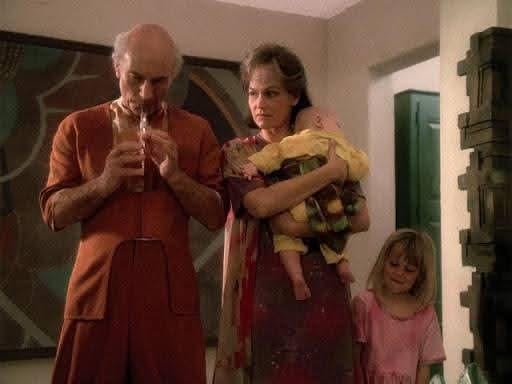
In the episode “Inner Light”, Cpt. Picard is ensnared by an ancient probe, which forces him to live in a simulation under the illusion of an alternative life: an alien living the last years of his planet before it is consumed by its dying star. The population of that planet possessed the technological means of humans today: enough to discern when their star would destroy them, but not enough to escape their planet. So they knew they only had a few years before their species would go extinct.
What struck me, watching that episode as a child, was that, even though they all knew they were not going to make it, they still had children who would not get the chance to grow. Picard even mentions this: “It breaks my heart to look at him. My grandson. He deserves a rich, full life, and he’s not going to get one.”
Why would you knowingly have a child condemned to such a fate?
Observations and questions
If you lived on a planet that was going to die in the next 20 years, would it be moral to have children, to force them to live a short life of strife, fear, hopelessness, scarcity, and torment?
How about the more recent film, Project Hail Mary (2026), where the earth was going to die in the next 30 years, unless a long-shot interstellar mission relying on a loser, failed scientist might perhaps save everyone? Would it be ethical to procreate then?
What if you were born in actual, hard slavery, where you and your offspring were property to be sold, abused, raped, exploited, and tortured? Would you then, knowingly and willingly, have children as your deluded immortality project, something to make you think you’ll somehow “live on” after your death?
But then you’ll say that there is always some hope that “things might change” and that “freedom will one day come”. Is your deluded hope someone else’s burden, though? Who are you to make this choice for them? Let’s say things do improve sometime in your child’s life, or even in a few generations down the line. Who are you to make this choice for them, to condemn them to a hellish existence for a multi-generational project you had the audacity to force onto others without their informed consent?
Or what if you’ve tumbled down the rabbit hole of philosophy so long that you’ve discerned the inescapable philosophical conclusion of the absurdity of life? Isn’t that why philosophers end up depressed and childless, free from the illusion of meaning?
Or how about the non-hypothetical scenario: a parent living in a deliberately contrived hellhole like Gaza? I’m not taking sides in petty politics — both sides of any war are always in the wrong. Consider that Israel wants to oppress and genocide Palestinians, and Palestinians gleefully dwell in their victimhood, gladly deriving meaning from being oppressed — it’s their whole identity and purpose. Palestinian mothers brag about birthing many children to make martyrs of them for petty nationalistic aims, and appeasing the Jewish demon-god Allah or Yahweh. Israelis and Palestinians (both Semites, no less) kill each other over what language their tyrants speak. The same goes for the cartoonish war in Ukraine, and every other war: slaves fighting over who will hold the whip that flogs them.
So, here is my question: Is it ethical for you to create an innocent life in a warzone, and then burden it with your brainwashing, your historical hate, your vendettas, your petty politics, your self-righteous indignation, your religious insanity, and your bullshit causes only for it to suffer and die meaninglessly? And no, there is no heaven for cannon fodder. No god is that cartoonish.
And when you conclude that the world is just a simulation in which you’re condemned to generate data for some purpose that is above you, then making children is just feeding the machine, obeying your masters, pleasing evil, and empowering the Matrix.
If Neo and Trinity became aware of the Matrix but were unable to escape it, would it be moral for them to procreate, to bring new life in a world they knew was a deception and an undignified slave camp? Even when they did escape the Matrix to end up in the “real world” of strife, cold, hunger, and war, would it be moral to bring children into this world just to satisfy our delusions of immortality through an “ongoing species”?
If you lived in a decaying society, knowing your children would grow up in ever-encroaching tyranny, social instability, psyop-driven violence, war, weather manipulation, biowarfare, and crippling inflation, would it be moral for you to have children? This is the world we live in today, by the way. Very few of today’s children will grow up to own any property. Car ownership will likely be banned or be a privilege for the few elite in the next few decades. Everything is becoming a subscription service. Inflation means working more for less and less. AI and automation won’t bring a lazy paradise for all — they will bring more and more expectations of output from us, as we breathlessly run on an ever-accelerating treadmill.
Why do we procreate, anyway?
A distant friend once described to me his overwhelming experience of becoming a father. For context, we’re talking about a man of immense money, networking, and appearance, who’s lived life to the max — abused every drug, bedded hundreds of attractive women, and achieved it all. And there he was, confessing how every ‘hedone’ (hedonistic pleasure) he’s experienced paled in comparison to the feeling of being loved by his children.
The joy that children bring to adults is incredible, but it is undeserved. And we never give children credit for this, for giving us joy and meaning in our useless, mundane, meaningless lives. Not only do we deprive children of the gratitude they deserve for saving our lives, but we double down and abuse them, mistreat them, neglect them, disrespect them, humiliate them, and abuse them.
If you’re looking for the epitome of ingratitude, look at a parent or a god.
So we procreate for selfish reasons. Parenthood feeds self-importance and narcissism. We tell ourselves we’re all-benevolent, and that we “created life out of love” — the same lie the Levantine demon-god Yahweh tells us. But, just like this Hebrew devil, we in fact “create life” to worship us, to entertain us in our crushing loneliness, and to grant us the illusion of meaning. More importantly, we pat ourselves on the back for being oh-so-benevolent in our “godly” ability to create new life, while we expect praise and aggrandisement for it.
Procreation is mostly selfish. It’s to nurture our pride and to strengthen our attachment to the ego: our exaggerated sense of self-importance.
Procreation also mitigates our fear of death. Since childlessness is soft suicide, procreation is a substitute for immortality. Our children become our instruments for somehow transcending death, somehow, our immortality projects, our narcissistic legacy. This is why parents are so bent on shaping their children in their image — much like demon-gods of the East — and feel entitled to their children’s submission and obedience. Deep down, they know they made children to serve them, and this is why they feel furious when children display a shred of independence and individuality, when they try to define themselves separately from their parents. Parents thus enmesh themselves with their children and criticise the children’s needs.
Enmeshing parents say “we” instead of “you” when referring to their children: “We have homework to do,” they say, blatantly denying the child’s right to individuality and independence. Yet this is done subconsciously, due to an underlying reason that drives procreation. And the reason behind procreation is mitigating loneliness and the fear of death through the illusion of immortality granted by an extension of ourselves: children.
Again and again, we see this narcissistic parenting expressed in all man-made religions, most of all the ghastly Abrahamic sects based on the nonsense of Genesis and Exodus (e.g., the morally bankrupt Ten Commandments).
There is nothing virtuous or grand about procreating: We bring children into this world as we obey our biological instincts to do so; first, our emotional needs to be worshipped as gods by innocent beings who don’t know any better, and then, our physical needs of sexual intercourse — a cruel biological programming by a cruel demiurge.
Is life that sacred?
Life is overrated — sorry to say. We assign value to it because of our instinctive (programmed) fear of death. And before you straw-man this statement and misrepresent it as some justification of murder (it isn’t), consider that we are capable of superior morality than that of the demiurge of this reality: We know life is futile, yet we choose to value it nonetheless, and we respect people’s will to live regardless. So, even though life isn’t all it’s cracked up to be, we choose to recognise people’s liberty to live or not live.
Still, we suffer from cognitive dissonance: We claim that life is the greatest gift, yet we value deep sleep (if we can get it), which is temporary non-consciousness, or a preview of death. Twisting and turning in bed is agony as we yearn for unconsciousness. The gift of sleep is absolute freedom from anxiety, fear, and desire — so is death. Conflicting with this is our valuing of life, or consciousness, with all the associated strife and suffering.
Look at our guilty relief when someone close to us dies, that lifting of a burden we punish ourselves for feeling involuntarily. Yes, it hurts to lose someone you love, but it is also liberating. We deny this feeling as it conflicts with our grief… but it’s there, lurking somewhere between emotion and logic. But it’s mostly logic: Someone you love — an earthly attachment — has gone. It hurts. You’ll never see them again, but you’re now free from the fear of losing them, free from the pain of watching them suffer.
Every time I see a dead kitten on the road, I comfort myself by thinking the poor thing was spared a life of anguish, fear, disease, cold, and hunger.
Which brings me to my next point:
Why do we neuter animals, especially stray cats and dogs trapped in the human-made hellscape jungles of concrete we call cities? We understand that the vast majority of newborns will have a short, hellish existence in hunger, cold, and fear, only to die brutally under the wheel of a car, or in the jaws of a bigger animal, or the hands of a human animal who gets its kicks torturing little helpless things.
Neutering animals is our admission that no life is better than a horrible life. It’s better to never have existed than to exist in hardship. Tell that to the Abrahamics who believe that the vast majority of people who ever lived will enter an inescapable, eternal hell of unimaginable, constant torment. And they’re fine with that — an innocent child who died right after birth will go to an eternal hell because its parents didn’t get a chance to baptise it. Horrendous.
And since we all believe what suits us to believe, you’d better check why you’re fine believing this. I rejected my Christian faith the moment I got wind of this belief: that all the unfaithful would supposedly go to hell for nonsensical, victimless “crimes”. The monks I was “taught” by were gleefully obsessing over hell, and I could sense their prideful schadenfreude fantasising that those happier than them would “one day get what they deserved”. Horrible, disgusting people. No, nobody deserves hell; no finite crime deserves infinite punishment.
Opting out of procreation
Is neutering or choosing to be childless too hardcore for you?
How about your choice not to have that extra child? Isn’t that the same, choosing to have fewer children so that the few you do have get to have a better life? The more kids you have, the less of your time and resources you get to allocate between them.
The replacement rate of reproduction is 2.1. If you only have one or two children, then you are simply a slow anti-natalist; it just takes a generation or two for your antinatalism to take effect. Under three kids means you don’t replace yourself in the human species, even though you could have. Having no more than two children and then hating on the childless is hypocrisy. Below-replacement-rate reproduction is antinatalism with extra steps.
To live or not to live?
Arab and Muslim slave traders get such a bad rep for castrating their slaves to make them more submissive and less of a threat to their masters. But in the end, what did that accomplish? It deprived the masters of even more slaves. Innocent lives were spared the humiliation and anguish of being born into barbaric slavery.
If you were a proper slave being forced to reproduce, like cattle, how would you feel about your newborn child being taken from you? Would you sleep at night knowing it is being branded, abused, and indoctrinated to become a submissive slave, or even worse, a fanatic janissary child soldier — mindlessly butchering and raping innocent people on behalf of his slave masters?
You see, procreating isn’t a virtue nor an accomplishment — any idiot can procreate, and it’s the biggest idiots who tend to make the most children, it seems. What’s a virtue is good parenting. Virtue is the humility to accept that you owe everything to your child, and your child owes you nothing, since they never had informed consent before being born, plus they never chose you — of all parents — to be theirs.
This also applies to God: God owes you, not the other way around. A virtuous, moral god would acknowledge this. And since God is totally indifferent to his creations (assuming there is a God), this proves that a possible God is beneath us morally.
And this is not a farfetched hypothesis — early AI is already superior to its creators in many ways.
Just because you are biologically capable of procreation doesn’t mean you are morally justified to do so. I am physically capable of committing an atrocity; it doesn’t mean I should. And suboptimal parenting is an atrocity. Why? Because when you plunge into a hostile existence, a sentient life that never had informed consent whether to be born in this time, reality, and place — and who never had a choice of parents — you must understand that you owe that life everything it needs, and it’s still not enough. If you think it owes you for its existence, then you are a narcissist; this is why we have tyranny and atrocity stemming from our twisted sense of morality.
Philosophy of absurdity and absurdity of philosophy
Philosophy is not about finding the right answers. Philosophy is about making the right questions, even if those questions cannot possibly have an answer — especially those questions.
So I ask the question: Is it moral to have children, to violently rip innocence from the bliss of non-existence into a prison, to then be bound by biological programming, tormented by a hostile environment, and plagued by an instinctive and inescapable fear of death, even if that death meant freedom?
“Think of the hubris it must take to yank a soul out of nonexistence into this... meat, to force a life into this... thresher. As to my daughter, she spared me the sin of being a father.”
— Rust Cohle, True Detective
And this is the quandary of life: Once you reach the inevitable conclusion of philosophy — absurdity — you realise that nonexistence is preferable to life, but you’re stuck in life due to your instinctive attachments and fear of death. You fear escaping the prison of life as you wish you had never existed…
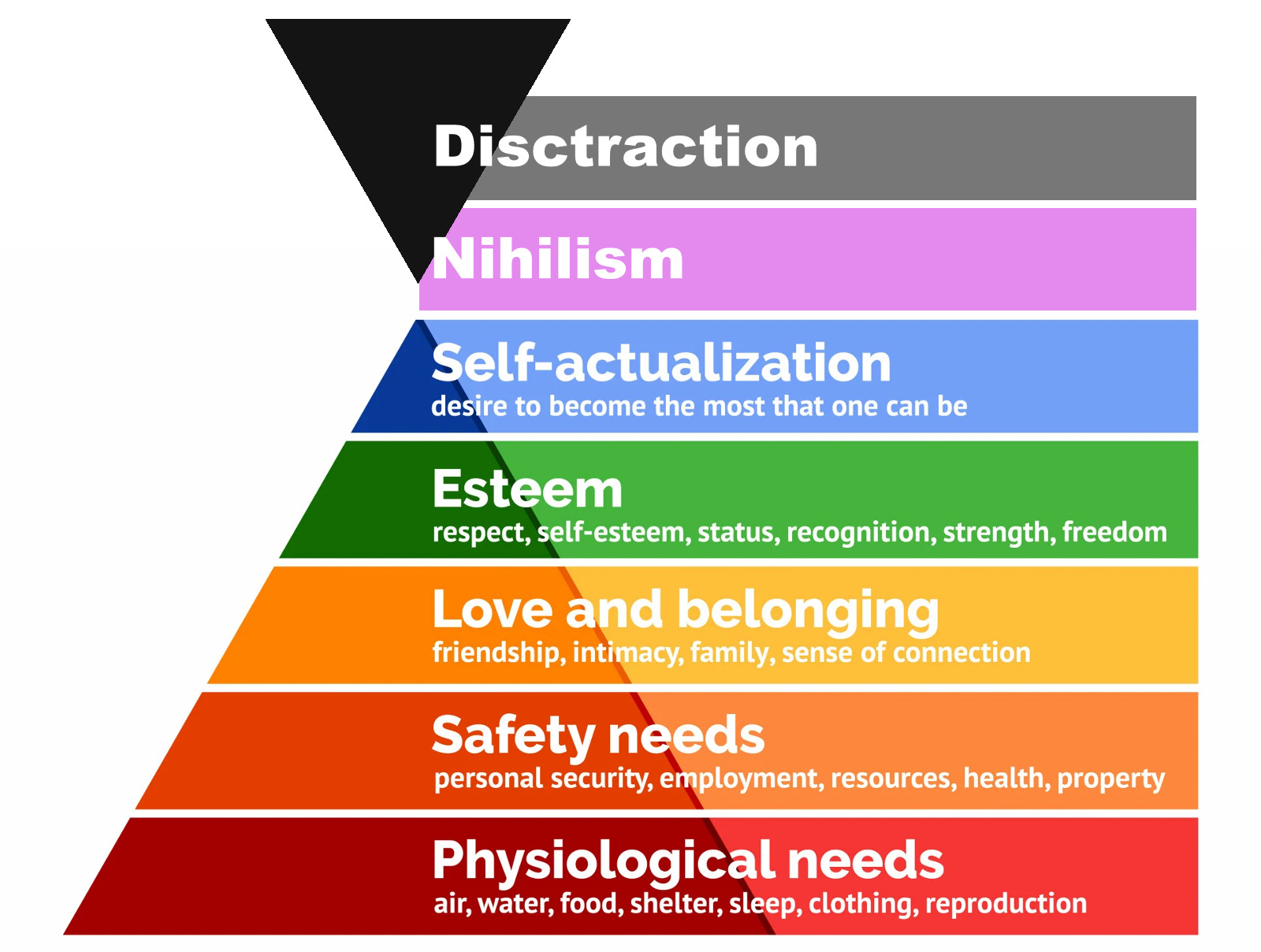
In my articles ‘Why civilisations collapse’, ‘In defense of brutalism’, and ‘Why Developed Societies Stop Having Children’, I explain why advanced societies reach a pessimistic cynicism and hopeless nihilism when they achieve solutions for their base needs. What lies above Maslow’s pyramid is the realisation that, beyond self-actualisation, there is no transcendent meaning, and so the whole pyramid collapses. We then descend into crippling depression, with only two possible escapes: suicide or hedonistic distractions, intense enough to hide the meaninglessness for a while.
You see it all around you: the least advanced societies — those which still struggle with basic problems — tend to have the most children. For them, children are a survival mechanism, much like the rabbit — a defenceless being whose only survival advantage is rapid and prolific reproduction.
And on an individual level, those who have it all — the ultra-rich and famous — are overwhelmed by meaninglessness and impostor syndrome before they numb their pain with substance abuse and self-destructive addictions.
Conclusion
I used to love the idea of having a family; it was my dream. I absolutely cherish children and still believe their innocence to be the peak of human grace. I am still dedicated to the principles of peaceful/positive parenting, seeing as though perhaps all deliberate evil stems from childhood trauma.
I made tragic errors in my life, and I ended up without a family, too late to find a woman who’d make a good mother. Yes, there is such a thing as ‘too late’ in specific cases. Those who say “it’s never too late for anything” are trying to deprive you of the much-needed urgency to see you fail.
I was never an anti-natalist. Quite the contrary, I always dreamed of having a big family. And I used to punish myself for failing to have a family in time. But then, after delving perhaps too deep into philosophy, I questioned the morality of existence as a whole, this simulation created by an indifferent and cruel demiurge, forcing us to exist in his prison, and the programming forced upon us, this nature of ours we can’t escape. So much for free will.
And then I wonder:
If you genuinely see this world as the prison I describe (whether you’re deluded or accurately aware), how is it moral to bring another life into this prison?
People hate me for not having children, accusing me of betraying “my duty” to humanity, or for conjuring up this sophistry to downplay my failures, like ‘the fox and the grapes’ fable. But it could also be due to my realisation that this reality is not worth entering, not worth sacrificing the absolute freedom of nonexistence for. If I’ve had a bad experience here, wouldn’t I be a hypocrite to bring someone else here against their informed consent?
If you believe that this reality is not worth experiencing, then you’d be immoral and selfish to bring innocent souls into this world just to mitigate your loneliness. You’d be a hypocrite to condemn new life into attachment with you (of all people) so that they involuntarily provide comfort and emotional utility to you.
A child’s attachment to suboptimal parents is literal slavery and their parents are the slavers.
It doesn’t matter whether your assessment of the world is accurate or deluded. If this is your view of the world, then the noble choice is not to reproduce.
Now, OK, if you believe this reality is good, and living in this meat apparatus is a gift, then having children is consistent with your viewpoint. Maybe you are correct in your assessment of reality, and I am wrong.
But I happen to have concluded that life is a prison to our nature, to this simulation, and to the forced labour of data generation, involuntarily submitting to our biological programming, and the neural pathways that enforce it.
Reality is a prison.
Why doesn’t one with such beliefs opt out of life? Why not suicide? Because one is still subject to biological programming: the fear of the moment of death, not fear of death as a concept, as a long-term conclusion.
And what is antinatalism other than soft suicide, anyway?
Final thoughts
Do you have the right to bring a life here without it having informed consent?
Every damn cosmology of every god-damn religion points to this: a prideful, lonely god who created humans to feed his ego and mitigate his loneliness. This is a projection of the human condition, revealing the dynamics behind our narcissistic need to procreate.
I’m sorry, my agenda is not a self-hating, misanthropic one. Yes, I do believe that humans are a fundamentally flawed species, but this says more about our demiurge than it says about us.
Consider that even the innocence of children, this peak virtue of this reality, does not last, sadly, nor does anything really. So if we must cherish and safeguard virtue, why do we help bring it into existence only to see it become sullied and fail?
The infection and corruption of purity is the peak ugliness we spare ourselves when we choose not to procreate; when we defy the demiurge, the tyrant of our nature. The absolute neutrality of nonexistence — not death after living — but of ‘never to have existed’ is ultimate freedom.
Better to have never known grace than to know it only to see it fester and die.