

Holding God Accountable
What does your image of God say about you?

We are taught self-accountability from the example of our parents. Parents who hold themselves accountable for their children provide a solid example for those children to become responsible and self-accountable themselves. When parents absolve themselves of all responsibility for the well-being or distress of their children, then they teach those children, through example alone, that accountability can be avoided.
God, or the demiurge, is the ultimate parent, the creator of each of us, but also the inventor of our nature’s parameters. This makes it even more morally responsible for us. It baffles the mind that we demand from mere humans responsibility for providing the best possible environment for their children, yet we don’t hold our supreme parent, the demiurge (whether real or not), to the same standard.
If your religion absolves your god of its moral responsibility towards us for bringing us here and abandoning us so irresponsibly, then what does that say about you? What does your religion teach you?
Is it any wonder why the world suffers from a severe lack of self-accountability, which leads to traumatising childhoods, insane behaviours, and total submission to unaccountable “authority” figures? Perhaps it all starts with our deeply flawed religiosity that absolves parent figures of accountability, starting with the ultimate parent: god.
…Not to mention the worst parent imaginable, Abraham, the father of Judaism, Christianity, and Islam. This is the vile example of parenthood that hundreds of millions of parents have…
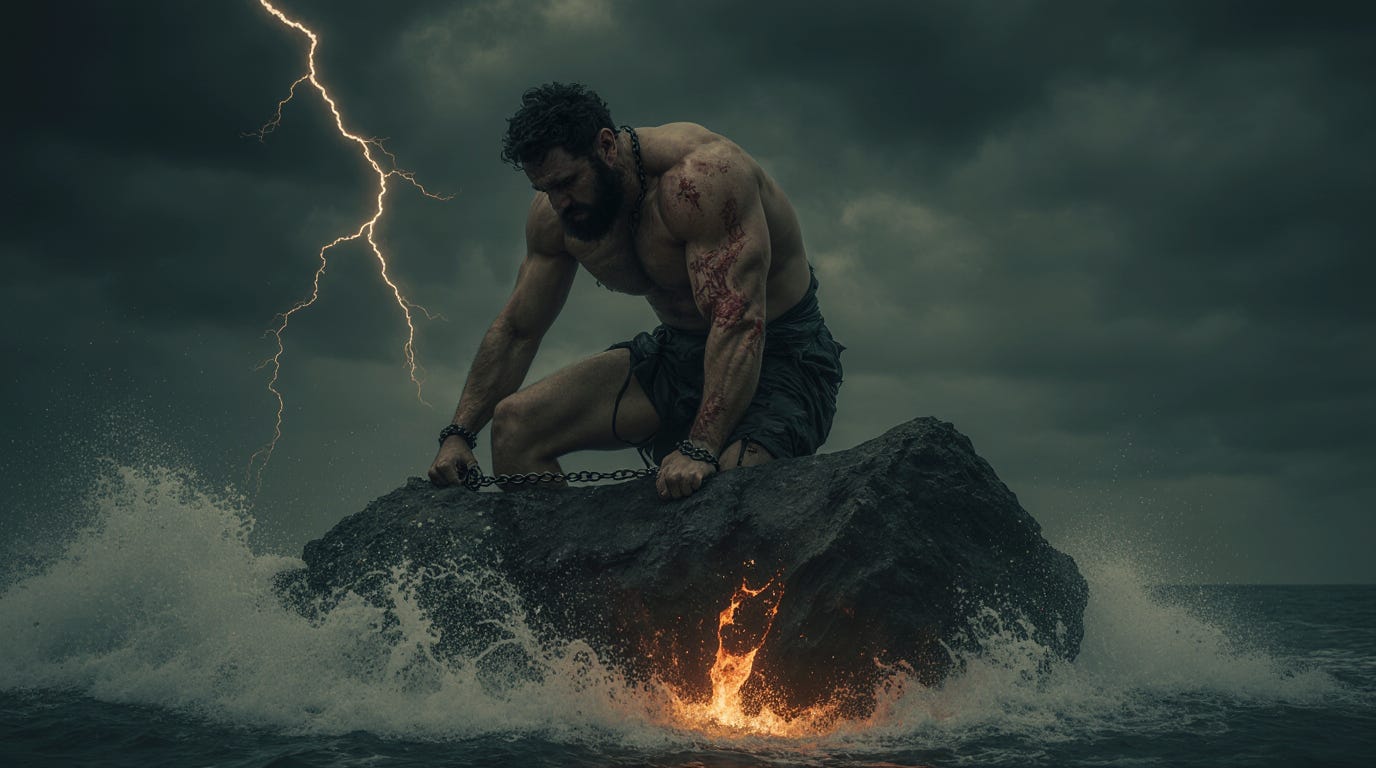
Prometheus
The story of Prometheus is packed with meaning and condensed with philosophical questions. It is by far superior, intellectually and literarily, than anything I’ve read in the Koran or the Bible, save for a number of Jesus’s quotes that are truly inspiring. Jesus, in my opinion, was ultimately trying to preach against Judaism, but his message was co-opted by Roman political interests instead. But I digress.
The premise of the story of Prometheus is that this titan or old god gave humans the gift of fire, or knowledge, which was deliberately withheld by Zeus, the god of gods. Zeus, being a petty, tyrannical, jealous, and insecure little dweeb much like Yahweh of Hebrew mythology, decided to punish Prometheus in an eternity of needlessly sadistic torture for the crime of being kind to humanity, for helping humans… humans who were abandoned by their creators in a hostile environment without the guidance to survive and thrive.
The story of Prometheus teaches us that people from ancient antiquity, way before Hebrew mythology dragged us all backward thousands of years, were bold and intellectually honest enough to question the morality of the demiurge.
Prometheus dares to defy the god of gods, Zeus, and accuses him of being tyrannical, unjust, and lacking compassion for humanity. He does so knowing full well that Zeus was much more powerful, demonstrating how adherence to moral principles is superior to “authority’ by rule of violence.
His defiance was a simple act of compassion towards humans, which Zeus punished in the most cruel manner, which actually proves Prometheus right: that the demiurge is amoral and immoral. This is the ultimate in moral courage: upholding moral principles in the face of annihilation.
Unaccountability
There is an unaccountability epidemic in the world. This is why we all look to tyrants to solve our problems for us, instead of creating local, decentralised initiatives ourselves. And this selling of our souls to the devil of the state ends up creating even worse conditions for us.
You can’t be self-accountable when you don’t similarly hold accountable the unaccountable, such as neglectful parents who refuse to take responsibility for their children; the moral imperative and obligation parents have towards children… children who had no say in being born, or in choosing their parents.
And what about the most neglectful parent: god, or the demiurge, who ripped us from blissful nonexistence to dangle in front of us false hope, and then torture us with denied love, unachievable dreams, frail bodies, and even frailer souls… who condemned us to surrender to our needs and biological programming, and the ultimate failsafe: the fear of death, the self-preservation instinct… and who then abandoned us to a hostile environment of scarcity and randomness, like throwing babies in a hazardous construction area, and calling it “free will”.
No one can be genuinely self-accountable when they refuse to hold others accountable too, especially those with the power, the control, and the moral obligation towards others. The more power one has, the more responsibility. Even Spider-Man knows this.
Thus, if your image of “god” is all-powerful, then it should also be all-accountable. Otherwise, we perpetuate the vile, immoral notion that power is not responsibility, but rather, it is deluded entitlement.
I believe humanity will never prosper unless self-accountability for everything that is under our control becomes a primary driver of human behaviour. Lack of self-accountability makes us cruel, uncompassionate, and abusive, thus causing generational trauma that perpetuates the self-sustained cycle of abuse. For example, parents who aren’t self-accountable tend to treat their children with disdain (mainly due to the jealousy of youth). Most parents refuse to admit that they have almost absolute control over their children’s emotions and that they owe everything to their children. Parents have more impact and control over the feelings and actions of their children than the children have over their own feelings and actions.
And I believe parental abuse — the source of almost all evil — starts from not holding accountable the ultimate parent figure: the demiurge. This “divine parent” not only violently brought us here, depriving us of blissful nothingness without our informed consent, but also has absolute power over our physical and mental nature, and even the circumstances of our environment. Yet, human parents demonstrate more responsibility, more compassion, and more morality towards their children than a god does towards us.
If a human parent asked their children to slaughter a child to prove their devotion, would we consider that parent moral or even sane? Yet, we herald the vile, vomit-inducing, and quite satanic story of Abraham as somehow the epitome of morality?
So, why are “gods”, to whom we attribute all morality no less, less moral than humans?
Excuses for the god-tyrant
The least self-accountable entity imaginable is the deity of the Bible: Zero accountability, zero morality. Nothing like that is worth worshipping; only feared with the utmost horror.
Nothing has benefited from more excuses than the demiurge who has created us, abandoned us recklessly and irresponsibly, as slaves to our nature in a hostile world without guidance or at least the mercy of some communication. We make up excuses for this god-tyrant, like “God gave us free will”, or “it’s to test us”… all arbitrary rationalisations and ad hoc fallacies. All the while, human parents (the good ones at least) are much more moral, caring, and responsible for their children than the demiurge(s) of this reality. Imagine throwing your baby in a hostile environment all alone, without guidance, protection, consent, or even contact, and then demanding to be worshiped as you baptise your indifferent abandonment “free will”.
We make up excuses for a tyrannical, unaccountable god, so then we make excuses for a tyrannical, unaccountable government, and for all our abusers. Victims afflicted with Stockholm syndrome erupt in an unhinged and aggressive manner the moment you try to hold their abusers accountable. Likewise, a statism apologist will foam at the mouth when you suggest that the mere concept of centralised coercive government is evil. And a zealous religionist will go ballistic on you and threaten you with hell when you suggest that it’s unfair to be made and abandoned without any guidance, at least.
Imagine reading the story of Abraham and not concluding that Yahweh is an evil, cruel tyrant worthy of nothing other than horror and contempt from us. And whatever happened to free will? Was it “free will” when Yahweh toyed with Abraham, Lot, Job, Samson, Moses, and even the pharaoh, and all those people this odious “god” didn’t mind intervening with? Imagine thinking that the vile Abraham was somehow virtuous, the psychopath who, without protest, rushed to obey the voices in his head ordering him to slaughter his innocent child.
What would Prometheus do in Abraham’s position?
Morality
It’s funny how the most vehement, frothing-at-the-mouth proponents of “objective morality” can’t seem to recognise the stare-you-in-the-face truth about the amorality of their god, whether from deducible observation of reality, or, even worse, from their own holy texts that blatantly depict their god as being even more immoral.
Nothing is above morality. Not even god. When we make excuses for an amoral demiurge (whether real or not), we lose sight of morality, and then we pretend to wonder why the world is so insane and cruel. Is it because we are terrified of the demiurge with the power to torture us endlessly? Yes! Of course, that’s it. We are afraid to hold the demiurge accountable, lest we end up like Prometheus. But this is all the demiurge gets from us: horror and the pretentious excuses that come from it. Here’s one thing this demiurge cannot do: earn our love — and I mean true, meaningful love, not the sick, deluded Stockholm-Syndrome attachment of twisted masochists in love with their sadistic abusers.
The question of accountability
Who am I to hold god accountable? No one. I’m just asking the philosophical question: Why isn’t the demiurge self-accountable? And why don’t we hold this demiurge accountable, like Prometheus did, even if this demiurge is just a product of our imagination?
And what if this demiurge is real and creates us with purpose, but lacks self-awareness or even consciousness? What if we are just a bad dream of a massive, timeless, and confused entity? Well, we still need to hold it accountable. Otherwise, how would we, the creations it felt the need to create, help it learn anything? And maybe this is what we are to nature, or god, or the demiurge: insignificant nodes in a simulation that have no individual worth for its creator.
The blinding truth
The demiurge has abandoned us here helpless in a hostile world to stumble in the dark, without the capacity to ever reach the light. This is demonstrable, observable, deducible reality. What do you conclude from it? Beyond ancient, badly-written, contradicting scribbles by uneducated desert dwellers obsessed with foreskins, what does your experience tell you of this existence? That nature, or the demiurge, or whatever created you — conscious or not — is totally indifferent to human purpose or suffering, and that our struggles are totally needless and pointless, regardless of arbitrary rationalisations and mental gymnastics we conduct to romanticise and “justify” suffering, and to arbitrarily (and narcissistically) grant our own lives meaning as if it were for us to do so.
Conclusions
A “god” that demands to be “feared” does not deserve or earn our love or worship. It only earns our horror, like we fear the plague or a nightmarish monster that is irrational and impossible to reason with.
The concept of morality, despite being elusive and hard to objectify, is a higher ideal, and perhaps the highest virtue achievable. If humans can achieve a certain moral framework that is superior, more compassionate, more accountable, and more loving than anything given to us by the demiurge of this reality, then the demiurge, it seems, is morally inferior to its creations, just like humans are inferior to AI in many ways. Who knows in what other areas AI, our creation, will surpass us soon?
So, it is possible for the simulation to surpass the programmer. It is possible for us to morally surpass an amoral “god”. Maybe we don’t have power in this inescapable cage of our existence, but we seem more capable of demonstrating morality than the demiurge. We don’t abandon our children like the demiurge does, despite nonsensical mental gymnastics like “it’s god’s plan” or “god works in mysterious ways”.
As its moral superiors, we cannot and must not forgive the demiurge for its cruel indifference towards us, the creations it abandoned in a hostile reality without informed consent, guidance, or even just an answer to the one fucking question we are programmed by it no less to need answered: Why the fuck are we here?
It doesn’t matter whether the demiurge is real or we are just random creations of a Big Bang improbability. In the way we imagine the demiurge through manmade scriptures, we project our morals, just like we do in literature and cinema. If we illustrate the absurd, sadistic god of Abraham, Job, Lot, and Moses, and consider it somehow moral or worthy of love, then what does that say about us?
The ancients (who predated backward Hebrew mythology) at least had the decency to weave the story of Prometheus, and thus express their response to nature’s indifference: holding their gods accountable for the abandonment of humanity.
If you’re going to imagine God, at least honour Him enough to ascribe Him with self-accountability.
I hold a similar view of God, in that, He has to be held accountable for the things He has created. He went ahead and created the world knowing what would happen to all conscious creations: all of their pain and anguish. He atones for this decision by resolving these ailments over time, through serendipity, though people, and more - a process that has taken and will continue to take billions of years.
There is a curious pattern, though. One can simultaneously believe this to absolve themselves of responsibility. "God will handle it; I don't have to do it" and "God made me this way; this is why I don't recognize the truth." But then again, such a mindset could be resolved by that common verbiage of "being of the same essence as God," especially in being a finite form containing all of God's infinite qualities.
Embracing this, one is less likely to eschew responsibility for the things they do, nor can they pretend they don't know. Funnily, self-honesty may very well be one of those infinite qualities.
I don't have an image of God but I like to imagine that God has an image of me. I don't see life as being any less of a trial whether there's a God or not, so I just appreciate existence with it's joys and suffering regardless of who's accountable to who. Maybe there's some sort of default setting, that would be very practical.