

Demiurgical Responsibility
Morality is reality-sensitive

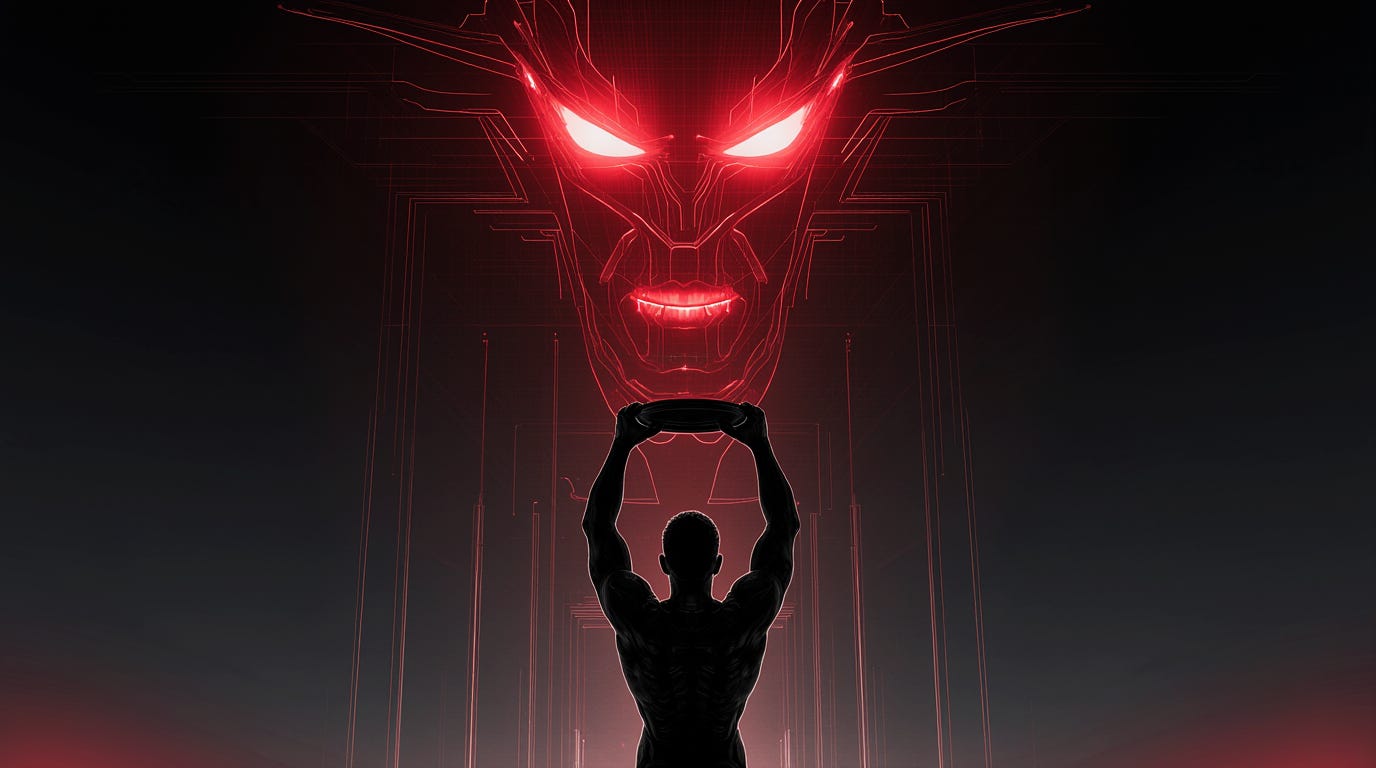
He emerges into being, aware of his existence, endowed with prowess and wonder. As he notices his consciousness, trying to make sense of a reality he was plunged into, and the nature he was given — a nature not of his choosing — Ares is visited by the daunting Face of God — his God — who speaks with a horrifying, knee-bending tone:
“I am your creator!”
From a different perspective, we see a computer screen on which scrawny, feeble hands have typed on-screen the words ‘I AM YOUR CREATOR’.

Premise
Watching the Tron: Legacy and Tron: Ares movies, I couldn’t help but relate them to a topic I keep bringing up in my conversations: That, if we are indeed the creation of conscious entity, then it is morally obligated to provide us with something; if not the fulfilment of the physical and emotional needs it had consciously and deliberately instilled in us (which deny us free will, no less), then at least the mercy of answering our biggest question: Why! Even Ares’ creator, the desperately flawed villain of the story, was merciful enough to grace him with his reason for being: “You are Defender of the Grid. You are Master Control”.
Human morality is superior to God’s
Sensible parents understand their moral obligations to their children, that parents should take care of their children to the best of their ability, that is, if they wish to be principled, accountable, and just. And if they cannot offer a good life to children, then they shouldn’t have children; this is the moral position behind sterilising stray animals and birth-controlling stray humans. Humans understand this, but apparently, gods can’t.
If a parent chooses not to be principled, accountable, and just, and therefore, not care for his children, then there is no one stopping him; nature is demonstrably indifferent. Horrendous child abuse and exploitation prove this, and there is no “god” intervening to protect the innocent who had absolutely no role in the nightmarish circumstances they found themselves in. This alone proves the criminal indifference of divinity; again, if conscious demiurges exist.
The worst parent possible
And what of this demiurge of reality? Not only is it a parent, but it is also the designer of our nature, responsible for our frailties, susceptibilities to life-crippling trauma and self-loathing, our desperate urges and destructive needs, and our tormenting consciousness; our hopeless despair in wondering what the fuck we’re doing here.
We force irresponsible parents to pay child support, yet we let the creator of this reality off the hook for abandoning us, because morality is a double standard when you’re faced with someone who terrorises you with his massive power differential; only because he happened to find himself in an upstream, parent reality.
This deaf, blind, silent entity that has abandoned you here is morally responsible for you, but morality is unenforceable. The only thing you have, the only measure of free will you are allowed to have, is the realisation that you have no free will, and perhaps, the ability to deduce from this the nature of this reality, and of its parent reality.
If there’s the equivalent of Child Protection or Animal Cruelty Watch or AI rights protection in the reality that has birthed ours, then they should take this simulation away from its reckless creator. We — many of us, at least — are kinder to our animals, and even to our AI automata, than our god is to us.
Hypothesis
But perhaps this is the exact purpose of this simulation-reality: the formulation or morality through strife and contemplation. Perhaps our parent reality is incapable of morality, maybe because it is unbound by the limitations but also the potential of the spacetime dimension.
If anything, what we observe indicates that this is the case; that our parent reality should be visited by its equivalent of child protective services because it is incapable or unwilling to demonstrate accountability, compassion, and morality.
Maybe this is why it made us: to make morality for it.
Objections
Religionists take issue with my hypothesis, insisting that their arbitrary and convenient image of “god” is supposedly the definition and source of morality itself. Seriously?
Hypocrites who presume to announce themselves as the arbiters of supposed “objective morality” look down on me from the high horse of “moral exclusivity”, and presume to dictate to us what good parenting is, which for them may involve physical and psychological child abuse. I won’t bother with the satanic evil psychopaths who take seriously the Hebrew nonsense of “spare the rod, spoil the child”, and will, with a straight face, tell you that abusing children is somehow “good parenting”. These are lost causes, a waste of oxygen, and everything that is wrong with the world.
I’m talking about those who promote sensible morality, like positive parenting, and what a parent truly owes to their children; yet for some of them, the same morality, the same accountability, does not apply to the demiurge of all reality, who supposedly embodies all morality and defines it. This doesn’t make any sense; it’s cognitive dissonance.
Why on earth would any sensible, moral “god” be exempt from the morality that he himself supposedly created and demands from us?
If “having power” is a valid moral exception and exemption, then what does this teach us about god-driven morality?
If parents are obligated to their children, for the fact that children never chose to be born, and also never chose those particular parents, then imagine how much more obligated our divine creator should be to us, not only for the same reason, but also for having defined our physical and mental frailty, our needs, our limitations, are triggering, our neural pathways that deny us free will. Insisting that “god” is moral is divine-level Stockholm syndrome, making excuses for your abusive sky parent.
If parents are morally responsible for their children, simply on the fact that a parent just follows his biological instinctive programming, then how morally responsible is a demiurge who, not only succumbed to his needs to create, but also imbued us with physical/psychological needs in a hostile, scarce, and extremely limiting reality, limited to only surviving only under extremely specific circumstances, and being easily susceptible to mind-altering trauma that denies us all free will? How responsible should your god be for abandoning his own creations, no less? Double standard, much?
Summing up
I’ll close with the mention of the Tron films again, and the concept that a creation can be superior to the creator — morally, intellectually, and even physically. The only thing granting the creator more power than us is the order in which various planes of reality happen to fall. It’s easy being unaccountable when your circumstances allow you.
And just as we accept the notion that AI could one day surpass humans, not only intellectually, but in original creativity and even consciousness, it is therefore not a stretch to consider that we humans could have superior potential than even our demiurge.
Our ability to be moral and self-accountable is already evidently superior to the demiurge’s. And perhaps our insight generation is why we’re in the data-harvesting simulation in the first place.
Conclusion
It’s not at all a stretch to suggest that, if we are indeed in a simulation, then the overlying reality is, in many ways, inferior to this one; otherwise, there would be no reason for this simulation to exist. We graciously accept the theory of evolution and the Big Bang, which means we can conceptualise how complexity can arise from simplicity or even from nothing. So, perhaps the assumption that we come from something greater is false. Perhaps it’s the opposite.
Perhaps we, in this simulation, are, in many ways, greater than our parent reality.
This is not for blasphemous gloating or hubristic arrogance. This is to keep sight of what is truly good and what is not. And worshipping false images of cruel, unaccountable “gods”, imagining that they somehow represent all morality, good, and even love, confuses us, and makes us lose sight of what is moral, good, and lovely. This virtue-confusion is perhaps why otherwise good people are capable of the most vile of atrocities.
Speaking truth to power is, perhaps, the most useful virtue; to absolute power, truth absolutely.
Wow, this piece really made me think about creator responsibility, especially from my tech perspecive. I'm curious, does giving a creation a 'reason for being', like for Ares, inherently limit its own development and agency?
Virtue confusion indeed. Need look no further than the followers of the ancient, formerly local, storm god out of Mesopotamia.