

The Problem With Gratitude
Value in the darker side of things


You’ve heard it before: “silver lining, focus on the good in people, look at the bright side of things, be grateful for the good things”. I understand that the moment you focus on and appreciate the good things in a given situation, then you weaken the effect of the bad. For example, does your romantic partner maintain annoying habits around the house? Whenever you’re tempted to get annoyed, think about how kind, caring, thoughtful, and beautiful she is; once you do this, her annoying aspect will lose (some of) its grip on you.
However, this doesn’t mean turning a blind eye to all the negatives; otherwise, you stand no chance of fixing them. And even if they are beyond correction, you still need to be grounded in reality and maintain situational awareness, no matter how bad your situation is.
Why? Because there is nothing more beautiful than truth, no matter how ugly it is.

Introduction
A mindset of generic gratitude towards no one in particular is simply a focus on and appreciation of the good, a strategy to mitigate the effects of the bad. Fair enough; just like when you see a horrible headline involving “elite” paedophile rings. You knowingly look away from reality, and that’s understandable.
But this doesn’t mean the bad isn’t still there, or that you should ignore it. If you ignore the bad, you’ll never do anything about it, and the bad prevails.
So, if you only focus on the good, you serve the bad, whether you want to or not.
Let’s unpack this.
Gratitude is focusing your spotlight on the good, assigning more weight to the good so that, when you weigh the good and the bad, the good seems greater overall, whether realistically or deludedly. And this compensates for the bad.
Also, gratitude is adapting your standards, compelling yourself to place more value on certain things that happen to be good, and making light of the things that happen to be bad, much like ‘The Fox and the Grapes’ fable. The fox displays gratitude for the low-hanging fruit… this is where the expression comes from, by the way.
Gratitude is appreciating the low-hanging fruit, the less-than-ideal things that happen to be without our grasp. But these are the things we wouldn’t be focusing on had we the option of both low- and high-hanging fruit. Alas, this life is one of scarcity and hostility, so we have no choice but to manage our disappointments with our powers of self-delusion granted by our demiurge.
Indeed, gratitude is useful, much like blinders and earplugs are useful.
But what if I told you that this state of mind of ‘gratitude towards no one’ also serves those who intend to do bad? What if those who source the bad are served by your tendency to be grateful for the good while ignoring the bad?
Think about it: if you were a manipulating abuser, wouldn’t you want your victims to have this blanket “gratitude” mindset by which they try hard to disregard everything bad while focusing on the tiny instances of good in their lives? Isn’t that what Stockholm syndrome is: appreciating your brutaliser for handing you a band aid while ignoring the fact that it was he who cracked your skull in the first place?
So, having a generic mindset of blanket “gratitude” makes you vulnerable; it makes you a sucker for punishment, telling yourself you’re happy when you’re not. And this is especially true when there could be so much within your capacity to do to improve your situation.
Wearing blinders against the bad and only looking at the good will make you fall in love with your oppressors.
A personal story
I grew up constantly hearing my mother’s complaints about her unstable and abusive husband. Yes, my mother recognised that her husband was insane, illogical, unable to pace or handle his out-of-control, unhinged emotions. She accepted that the person she chose to marry (and stay with) was treating his family like dirt just to vent his frustrations and mitigate his anxiety — to transfer his trauma onto us. Yet, she kept making excuses for him right after she was done complaining and portraying herself as the victim.
She kept saying, “You must always look for the good in people. His craziness always passes, and then he’s OK.”
But the vast majority of the time, he was vexed, angry, abusive, and violent. It’s hard to appreciate one peanut in a cesspool. The bad in him vastly outweighed the good. I used to wonder what good there was in him, and I could find nothing at all other than an occasional absence of bad. And after a lifetime of feeling sorry for her, hurting for her, feeling her pain as all children do for their parents, I realised that you can’t be much of a victim when you make excuses for your abusers.
Like many of you, I also grew up in an extremely abusive environment. Both parents were abusive in very different ways, but one of the most traumatic things was feeling compassion (literally meaning co-hurting) for my mother having to endure an abusive psycho husband. I felt so sorry for her that I hurt just as much, if not more, witnessing her being abused. And then she would unload her pain on us, me more than my brothers because after a certain age I “began to look like her late father”, as she put it, even though, before her father passed, she used to scorn me for “looking like my father”, the husband she loathed, yet chose to marry and chose to stay with.
But then she decided to treat me like her “little man”, the emotional-support substitute for a husband she never had. And my father’s natural jealousy kicked in, so subconsciously, he saw me as his rival in the house. Of course, he’d single me out among my brothers to be extra abusive and punitive. And all that because we had to “be grateful for the good in him”.
At times, when my mother would dump her frustrations on me, I’d beg her to divorce. I used to envy kids of divorced parents at school: they got so much attention and sympathy, plus they used to brag about all the special treatment they received from their fathers over the weekend, since the fathers had every incentive to want to win over their now distant kids (wouldn’t want the estranged mother turning them against the father, now would we?) But my mother kept insisting that she couldn’t leave him because “of us”, which made me feel guilty on top of it all, as if she blamed me for being born, since my existence deprived her of the freedom to leave. Even when I said I wanted them to separate because I couldn’t take the constant screaming and shouting and threats, and yes, violence, she would change her story: “Your father is a difficult man, but he’s not always like this. He gets crazy, but then he gets over it. It passes. Focus on the good things in life.”
And this, from a young age, I realised that “gratitude” can be dangerous. Gratitude is Stockholm syndrome.
Analysis
“Being grateful” for and looking only at the good makes you tolerate the bad, which permits, enables, and emboldens the bad.
At some point, you need to also turn your attention to the bad if you’re going to put your foot down. Otherwise, “looking only at the good” becomes a coping mechanism that turns you into a submissive slave with Stockholm syndrome.
What do you mean by “look at the bright side”? Imagine your abuser voicing a hypocritical ‘sorry’ right after abusing you. You then choose to focus on the apology instead of the constant abuse. This gives the abuser a free pass, and even, positive feedback that whatever he’s doing is OK. Aren’t you, therefore, complicit here in your own brutalisation?
Abusers generally throw in occasional acts of performative care between their bouts of abuse against you. Abusers instinctively know that, when you’re in a state of terror, you will want to believe that your terrorisers are benevolent, so that the abuse won’t carry much negative meaning against you. The rationale is that, if you love your abusers, then whatever evil they inflict on you won’t damage your self-esteem as much, seeing as though it comes from someone who supposedly “cares” for you. You’ll want to sympathise with your abusers to avoid hating yourself, much like a cuckold. But in the end, just like the knee-jerk reaction of creating a false self, this strategy backfires badly.
So, a few random acts of meaningless, effortless, and faux kindness make it possible for you to literally love your abuser more than you love people who deserve your love. This renders you your abusers’ captive in body, mind, and spirit. You will side with your abusers over good people who never hurt you. You will surrender your heart and soul to them because this is the only way for you to cope with being abused.
And again, this is because your Stockholm syndrome supposedly takes away the meaning and intent of abuse: If you force yourself to love your abuser, then your trauma’s damaging effect on your self-esteem is lessened. But the side-effect of this “gratitude for the good in bad people” is that you keep enabling and encouraging more and more abuse.
Gratitude and discontent
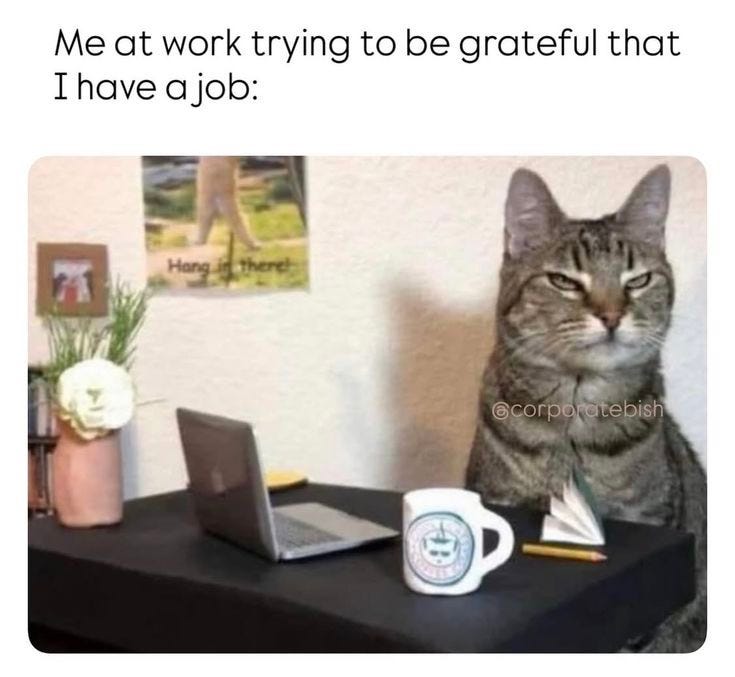
Sometimes, gratitude for things you need (not the things you want) makes you complacent and satisfied with nothing truly meaningful. Not only that, but this pretentious, performative, self-deluding ‘gratitude’ pacifies you when you should be angry and recalcitrant against your oppressors, or defiant in a situation that can only be improved or avoided through your discontent.
The proponents of ‘gratitude’ say: “You should feel grateful for having a roof over your head, for having food to eat, for having a family, even if they’re messed up.” I say to them: How about not feeling gratitude for meagerly satisfying your biological imperatives necessary for your base survival – needs you never chose to have, by the way – if you’ll stand any chance of actually attaining higher ideals, something with perhaps a glimmer of meaning?
True gratitude can only occur when it’s for things you want, not things you need. Honest gratitude occurs only for what you want over and above your base needs, and for delights you never expected. That’s why you feel gratitude: because you can only appreciate what you don’t need, but instead, want. Note: Read my ‘need versus want’ article for context.
If you need something, it means your desire for it is involuntary, much like our biological needs: imperatives we’re compelled to commit to involuntarily. We deep-down resent our needs because they are not of our choosing; our needs are chains of slavery, and you can’t be grateful for simply satisfying a need imposed on you by your nature. More on this below in the ‘grateful religionist’ section.
The grateful slave
The heaviest chains are those of gratitude. Slavery is sustainable only when you get slaves to feel grateful for their captivity. The state — this artificial monopoly of centralised governance — also does this: it violently strips us of the vast majority of our labour, offers us scraps from our own money, then demands our gratitude.
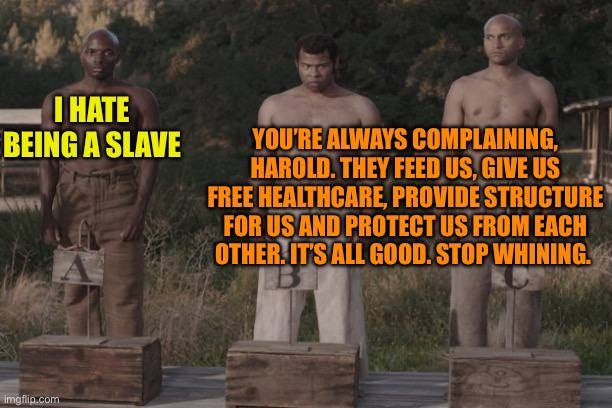
Gratitude to your slaver is what makes you a slave, one who deserves no better.
“She’s being nice! I’m pathetically grateful!”
— Mark, Peep Show
The need for mourning
Mindless gratitude turns you into a merry fool, pacified and useful to his enemies, but also mentally unhealthy due to your inability to resolve issues.
As Richard Bradshaw explains, you need to mourn to defuse the energy of the trauma. This means not resisting your pain, and embracing it without judgement, observing it, allowing it to show you what it looks like. You can’t keep avoiding your pain. This is why I oppose the psychological approaches that make light of trauma, and treat it as something you can fully control, nullify, or ignore.
If you can’t feel the anger and pain from the injustice you suffered, then you bottle them up, twist them under pressure, and then they re-emerge as psychopathic eruptions when you least expect it. You can’t expect to deny facing your trauma and expect it to disappear. The more you cowardly ignore it, the more persistently it’ll chase you.
“What you resist persists.” - Carl Jung
Gratitude disarms you and makes you vulnerable. Gratitude disallows mourning, and prevents resolution or mitigation of trauma. You need to feel wronged — not to play the role of the victim, but to deny identifying with victimhood. This is the rationale: You are not a victim, so you don’t tolerate being treated like one — you stand your ground and speak truth to power. You must treat any affliction, and all suggestions that you are a victim, as a violation of your non-victim identity. You do not accept being mistreated, and you do not tolerate being condescended to by those who will grant you patronising pity just to feel superior to you. Even when the power discrepancy is vast, and you can’t prevent your abuse, you can still allow your resentment and recalcitrance to support your true self of non-victimhood. But if you feel grateful for your abuser’s “good side”, you lose yourself: you become a willing victim.
You must reject gratitude. You must feel wronged, and for a while, mourn for your trauma if you are to discharge it, and thus lessen its weight on your soul.
Guess whom all this nonsense about “loving your enemies” serves; I’ll give you one hint: It’s your enemies.
Choosing not to love your enemies doesn’t mean you should focus on hate and vengeance. Anger, hate, mourning, and malice are healthy stages of trauma resolution; but they are stages. At some point, you will have to let go; to forgive those unrepentant who wronged you, but not absolve them. This means you have grown beyond your pain, and you have understood that, once you discharge the energy from your pain, you must let it go, because dwelling in anger and hate only eats you, and no one else. Forgiving the unrepentant does not mean you love them, or that you give them a free pass, or that you approve of them and their behaviour, or that you allow them back into your life. Forgiving means you grew beyond your trauma and you deprive them of the attention that keeps feeding the trauma they caused you.
You move on, as you grant explanations for what your abusers did to you, but not excuses. This means you deprive them of agency, but not accountability. It’s a way to mitigate the self-deprecating meaning behind the abuses you suffer, as I write in the ‘force of nature mindset’. They are not off the hook, but their actions are as meaningless as a random accident. You belittle them to the level of a mindless insect initiating a butterfly effect; but you still hold them responsible, and you still assess their character accordingly. Again, forgiveness is not absolution. Absolution, if not after an honest apology or penance, is earned after a change of behaviour. But that almost never comes, so don’t hold your breath. You forgive (but not absolve) your enemies for yourself, but you never love them or feel grateful for “not being worse”. That would be the mentality of the eternally willing slave.
The grateful religionist
Perhaps there is nothing I hate more than the story of Abraham, this vomit-inducing pornography, this superstitious wet dream by illiterate, desert-dwelling goat-fuckers which, embarrassingly so, is taken seriously by a huge chunk of today’s human population. The story of Abraham teaches you that you should be happy and grateful towards a demon-god who demands the brutal slaughter of your own child (without protest or attempt to bargain or even offer yourself instead), so that you can appease this insecure demon-god’s pathetic need for validation. Fuck Abraham, fuck Yahweh, and fuck foreskin-obsessed pedophiles who maintain this bullshit demon-cult. Yes, resenting Levantine superstition is a virtue. If you don’t instinctively recoil to its despicableness, I don’t know what’s wrong with you.
Gratitude to “god”? What “gratitude” do you think is owed to this reality or this demiurge? I think little to none.
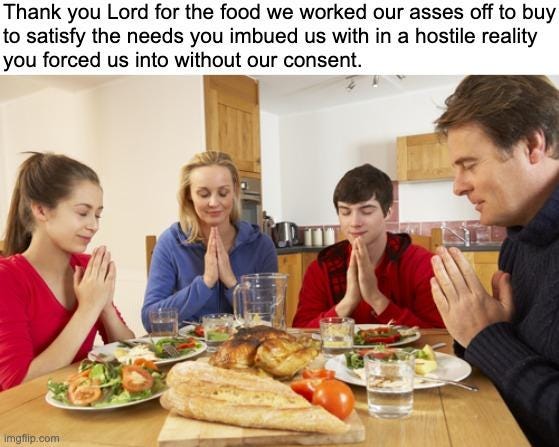
We owe nothing to an entity that brought us here without our consent, instilled in us biological imperatives not of our choosing, chose our trauma-defining nature for us, and threw us in a hostile environment full of scarcity and instinctive attachment to a meaningless simulation-existence.
If anything, “god” owes us.

Prevailing evil
Nothing is more useful to your abusers than your gratitude for their small, insignificant, and meaningless performances of faux kindness in between their bouts of abuse. This is how abuse is normalised, enabled, encouraged, rewarded, and perpetuated. This is how the victim becomes complicit in their own victimisation.
Gratitude deprives you of the necessary anger and urgency to fucking do something about your situation. Gratitude can make you complacent and inert. This obsessive focus on the “silver lining” keeps you from sheltering from the storm.
Gratitude gives you over-tolerance of situations that shouldn’t be tolerated. The best slaves are grateful slaves, those with the ability (or disability) to ignore the bad, which they then never get down to even trying to change.
Gratitude perpetuates evil. You need to stop being grateful if you are to set boundaries, to fight against injustice, to speak truth to power, to right a wrong,
Instead of dishonestly calling it “complaining”, how about you treat it as providing useful negative feedback, if anything, for the improvement of your abusers.
If you don’t complain about injustice, disrespect, bad quality, bad service, or ugliness, then how do you expect things to improve? I mean, don’t complain about petty things, obviously — be self-dignified. But when something needs to change, or when something encroaches on you in a way that threatens your self-identity, you can’t let it slide. If you are powerless to do something, then you can at least speak truth to power. And if you can’t even do that, at least resent your overpowering abusers in your mind. If you feel grateful for them, and if you love them, then you lose everything: you lose yourself, just like the coward Abraham who loved the voices in his head.
This goes for yourself too. Just loving and accepting yourself without any need to improve simply makes you deluded.
Gratitude can disempower you. Accepting the bad just because “it could always be worse” means you’ll never strive for good. Ever. So, doesn’t this maximise the probability of the worse coming to be?
Fair enough, sometimes, the more you kick against the pricks, the worse things get. Sometimes, the more you dig for gold the more you dig your own grave. That’s a fair point: Sometimes it’s better to stay content and not to keep striving endlessly for more and more. But is it always the case? Sometimes, you need to put your foot down.
The gratitude psyop
Make no mistakes: the power structures of institutional oppression (centralised government) have every incentive to condition you into a generic “gratitude” mindset. Look how toxic positivity is boosted on state-controlled media.
What if much of it is a deliberate psychological operation to keep you appeased and pacified, tolerant of your abuse and oppression?
The grateful slave is thankful for the scraps he licks off the floor of his masters. He relishes a moment’s peace in a lifetime of brutal indignities.
A grateful slave is a good slave.
Conclusions
The wife beater’s wife is grateful for her husband’s occasional good moments, and she thus enables and encourages his abusive behaviour. Why wouldn’t he keep beating her if he sees no consequences for his atrocious actions, if he gets no negative feedback for being a piece of shit?
Instead, the ungrateful man is more likely to have higher standards. He’s not a good slave because he’d rather die if it meant depriving his masters of his utility, and in doing so, keeping his dignity, integrity, and identity? Because what’s the point of living if you don’t know who you are?
Gratitude is not all bad. Well-placed gratitude can help you appreciate things, and to disempower the bad when the good is overwhelming. But make no mistake: you have to realistically assess the good and the bad if you are to make an honest comparison and assessment of a given situation. If you overestimate the good, then you have a skewed image of what you have, and you might in fact be living in hell thinking it’s paradise. When you weigh the good and the bad, be intellectually honest with yourself.
Seeing the silver lining or the positive in every negative can be a double-edged sword. It can give you resilience to endure hard situations but it can also curse you with unwarranted tolerance of situations you should be fighting tooth and and nail to escape from.
A reluctance to feel gratitude is not “being a doomer or a pessimist”; it is having the courage to acknowledge reality and accept your responsibility in your over-tolerance of things that shouldn’t be tolerated.
Gratitude can make you submissive, pacified, complacent, and inert. Your gratitude suits those who want to abuse you. They want you to be grateful for just the tiny things in life. They want you to have low standards for yourself. They want you to not want any better. They want you to be tolerant. This way, you allow them to get away with anything committed at your expense. This is why political religions like the Abrahamic cults are all about worshiping the demon-god Yahweh, who expects us to suffer his cruelty while also being thankful for it, like a wife-beater’s wife crying “I love you!” in between slaps. Yes, Yahweh, the demon-god of Abraham is one serious piece of shit, and so are those who concocted such a bullshit character.
Key takeaway
Yes, be grateful for the good, because the good — no matter how small — isn’t a given, and you could always lose it. This scarcity gives you an appreciation that increases the enjoyment of the good in a given situation.
But ask yourself:
Is your gratitude for the good blinding you to the bad?
Is your obsession with gratitude keeping you from setting higher standards for yourself?
Does your gratitude condition you to settle for less?
Sometimes, gratitude is a hedonistic vice, and ingratitude is dignity.
In reading this I was reminded of my reading of Ayn Rand's thoughts on the fallacy of altruism.
Very good take. I do believe, however, that there is also a key difference between "gratitude" that starts with, "Well, at least I have/do not have ..." versus gratitude that is felt when something truly good happens. The former emotion is, I think, generally pretty forced, whereas the latter is genuine, spontaneous, and overwhelming.
Also, as difficult as it is to read -- I am truly sorry to hear that you had to endure such a miserable childhood -- I always feel that I gain insight into my partner's family dynamic when I read your more autobiographical works. The mechanics seem almost identical -- same damned pattern. Thank you for sharing this.