



Freedom-oriented individuals (like me), for all their deep understanding of economics and human action, can often act as total cretins when it comes to communicating their message. And I’m beginning to suspect that many self-announced “anarchists” are nothing but state propagandists tasked with twisting the orderly and peaceful meaning of statelessness.
The loaded term of ‘anarchy’
When you use the word ‘anarchy’ to describe decentralised governance as opposed to the artificial, violently imposed monopoly of governance by the centralised state (the ultimate warlord), you do your cause a disservice.
I don’t care what the ancient Hellenic etymology and meaning of the word ‘anarchy’ means, or used to mean. Yes, anarchy actually means ‘the absence of authority’, not the absence of order (if anything, the absence of authority is more orderly). But language evolves. Most people perceive the word ‘anarchy’ to be synonymous with disorder, chaos, and Mad Max dystopias; an image that decades of state-funded propaganda has instilled in our brains, leading us to imagine statelessness to be a barbaric, chaotic free-for-all. Yet there is nothing more archaic, barbaric, and chaotic than the state, as we see the arbitrary making of laws, enforcement of laws, and genocidal wars waged against the will of the people involved (anarcho-tyranny).

When you speak of ‘anarchy’, most people either think you’re an antifa psychopath bent on destruction and disorder (another state-funded movement, by the way), or they see you as a wannabe warlord with aspirations of regional domination. Isn’t that what the state is, by the way: a group of warlords with absolute power over their regions, with our submission granted solely on the premise of the threat of violence?
I’ve said it before: stop using the word ‘anarchy’ because the inferred message is that you want to replace the state with nothing, and this scares people.
No, we don’t want to replace the state with nothing.
We want to displace centralised government with decentralised governance.
Governance services are a market, just like any other, and thus they function better when there is market pressure from competition, when customers can boycott to punish bad service, and buycott to reward good service.
Under the artificial monopoly of the state, you can’t just “take your business elsewhere” when it messes up, which it does by default, as all complacent, disincentivised monopolies do.
Because your state is the monopoly of governance services in your area, it dominates your area; you have no choice but to accept the poor governance services of the monopolist (the state) of any area.
Alternatively, with a decentralised provision of such services under competition, it is an inevitable fact that those services will be supplied more effectively and more efficiently; more organically and more cheaply. Statelessness doesn’t mean disorder; quite the opposite. Statelessness means more order, more peace, more prosperity, more fairness.
How governance services can be (and already are, to some degree) provided by competing vendors is beyond the scope of this article. But I urge you, if you value intellectual honesty, to read some of the bibliography I have carefully curated for you on the subject here: Stateless, Decentralised, Laissez-Faire Systems of Self-Governance.
Systems of governance are but a matter of belief
Ultimately, the system of governance that becomes feasible, sustainable, and desired for a given population is a matter of belief. This is why different styles of governance are feasible in one area but not in another: communism, Islamic theocracies, a Somalia-style unholy alliance of state and warlord, so-called “progressive” LGBT-worshipping democracies, or full-blown nationalistic fascism; all these rely solely on the beliefs of a critical mass of a given population.
If enough people understood and believed what I and my readers do, then we wouldn’t tolerate anyone elevating himself to the pedestal of “ruler”. We’d expect leaders in their field, subject to the scrutiny of competition. We wouldn’t allow a single, centralised, and monopolistic source of governance services. We’d instead put our money where our mouths would be, and we’d spontaneously give rise to demand for governance services by competing vendors, just like insurance companies (the state is nothing but one big risk management service, after all). If enough demand for such services existed, then there would be enough supply.
Belief is what gives subjective power to perceived authority, and to any social system. Faith is what gives subjective value to intangible things.
Just like commodity prices, fiat paper currencies backed by nothing, worthless stock of companies that never made a profit like Tesla and SpaceX, and the bluff of authority: Social systems work if people believe they work.
Belief is what matters, not objective knowledge. If you “believe” something is credible, valuable, or authoritative, then it becomes that, because “social systems” are arbitrary concepts, not objective reality. Sure, they are governed by certain natural laws, like incentives, but how we direct that incentive is a matter of belief. If you believe in yourself, you can do almost anything.
If you don’t believe in yourself, even if you have massive potential, you won’t accomplish anything. The same goes with systems of governance, whether centralised or not.
This is why education (or miseducation) is vital to the state and the church alike: if you can control the beliefs of most of your population, you can do whatever you want with them. And those who lust after power love the centralisation of governance; it gives them opportunities to rule over people.
If a critical mass of the people hold the belief that “we need a centralised monopoly of the state, otherwise we’d have chaos and disorder”, then of course, statism will be the only possible system for that population. If a state administration collapses (and they frequently do), it is immediately replaced by another type of statism, a theatrical rebrand to appease the masses and restore their trust (faith) in the centralised state.
Does this mean that the state is inevitable?
For a population that, as a whole, believes in statism, then yes, absolutely, the state is inevitable. And the brand of the state depends on the population’s beliefs. When the population changes its beliefs, the type of state swiftly changes, because it needs that belief; otherwise, it ceases to be sustainable. See the example of the USSR. The countries under the communist abomination that was the USSR were willing to take communist squalor for decades, until newer generations of people witnessed the prosperity of other types of states that allowed some free market competition (the only thing that brings prosperity). And then, just as people began behaving recalsintrantly against the state, defying it, and blatantly refusing to take its mandates seriously, the state rebranded, entering with “new freedoms”, an opportune loosening of the collar to appease the agitated slaves, and thus keep them captive.
Because most people believe in authority, so they will seek out authority. And when you fall for the bluff of authority, then authority becomes real, since your belief compels you to submit to authority; thus you make authority real. You never knew that behind the bluff of authority was a bad hand, a nothingburger, no moral authority and no necessity for authority.
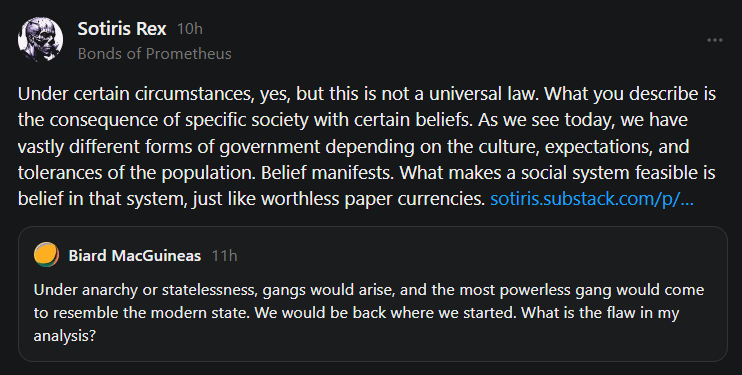
Don’t worry. If the world’s population of today ever found itself in a Mad Max scenario, it would instantly form regional states, because the state-obsessed people of today would seek out leaders. And isn’t this what happens in Mad Max, Waterworld, and every other parody of ‘anarchy’ out there anyway? Isn’t there always a leader or a community consolidated around authority figures, and these states war with each other because mindless drones are willing to obey just about anything from a perceived authority figure? Isn’t this what statism is?
A message to the sceptics of decentralised governance
You say statelessness is not possible… I say it is. Now what? Who’s to say which opinion is valid?
Most people share your opinion? That’s an appeal to popularity fallacy.
All of human history has seen some sort of authority-driven state? An appeal to tradition fallacy.
You can’t imagine how stateless decentralised governance would work? Appeal to incredulity fallacy.
Your use of fallacious and illogical argumentation should be a hint as to how (in)valid your opinion is.
That’s not even considering the fact that you fail to grasp how self-regulation already occurs even today under statism — despite statism — in matters of international trade and cooperation, and in black markets. Hell, even all the state’s corrupt dealings (bribes, lobbying, voters selling their votes in exchange for special privileges at the expense of others) all occur under stateless, spontaneous decentralised self-regulation, driven only by incentive. There is no state authority to force such agreements. The state proves its own unnecessity.
Ultimately, you get what you believe works, and you will never get what you believe doesn’t. The key is subjective belief only. People once believed social order wasn’t possible without child sacrifice, sacrifice, or witch burning. People believed that flight was impossible. People believed that space exploration was impossible. People believed that women couldn’t do just about any job a man can. We’ve passed all that, albeit very recently in our history. Only one thing remains: stop believing in the religion of the state, because that’s all the state is: faith-based archaic superstition.
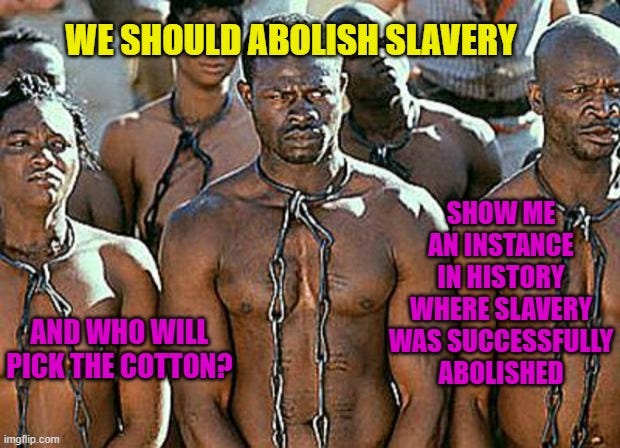
The state is inevitable only when enough people believe it is inevitable. The same goes with slavery, paper currency, useless stock like Tesla and SpaceX, and the bluff of “authority” by useless kakistocracy.
Statelessness is inevitable when enough people believe in it.
Currently, not enough do believe in statelensses, and it’s not because it isn’t valid; once, most people believed in rain gods, flat earths, and gods obsessed with foreskins (oh, wait!). Hopefully, one day humanity can escape its dark age (we’re still in it).
Vital reading:
Reading Lists

These books are a must (in my humble opinion) before you can hope to enter the respective thematology’s conversation. Do your due diligence first, get an idea of argumentation that goes against your own biases, and then make educated arguments. This saves the time wasted on already debunked arguments on all positions; plus it saves you the embarrassment…
Centralised Government vs Decentralised Governance

Centralised government, or the state, is a system founded on violence alone. Anything and everything the state does is driven by force or the threat of force. Whatever policy or “public good” the state presumes to impose on its populations, the imposition is backed by aggressive violence alone. Even
The Most Tragic Misunderstanding in History

Miscommunicated arguments against the state keep entrenching statists further into their cherished beliefs. And I don’t blame them.
The dumbest objections against statelessness #15

The ‘argument from incredulity’ fallacy presumes that someone’s stubbornly persistent disbelief in a particular subject, or their admission of lack of comprehension of it, is somehow a valid argument. No, your incredulity, or your lack of comprehension and imagination — especially as a consequence of your refusal to learn — is not a valid argument. Your…
Competition Is Always Superior to Monopolies & Oligopolies. Here’s Why…

Antagonism drives self-improvement. Rivalry fuels excellence. You wouldn’t be improving yourself unless you felt the need to excel against a benchmark set by your immediate competition. A sense of scarcity and a fear of loss incentivise you to keep working hard; first to serve yourself, and then to serve others. And serving others well ends up serving y…
The Corrupt Voter

We love pointing out the corruption in our politicians, but no one seems to be addressing the corruption in the voter, the source of state corruption in the first place.
Stop using the words "anarchy" & "capitalism"

The words “anarchy” and “capitalism” don’t mean anything anymore. We can appeal to their etymology or definition all we want, but the fact remains that they mean vastly different things to so many different people. This makes it impossible to communicate what you truly want to communicate whenever you use them.
The dumbest objections against statelessness

A collection of straw men, non-sequiturs, false dichotomies, false equivalents, false attributions, appeals to tradition, appeals to emotion, appeals to incredulity, and simple odes to sheer stupidity.
Excellent. There are many I would love to share this with but know they would not read it.
I see your point. However, they will appropriate and defile any word you choose, just as they've done with 'anarchy', 'liberal' and countless others.
Perhaps we are better off not getting too invested with any particular word altogether.
That said, I like the slogan "10,000 Liechtensteins".