Defending the Indefensible
When speaking absolute truth to absolute power becomes the only moral avenue


I see these apologetics “defending God” when God’s alleged “benevolence” is questioned in the face of all the suffering in the world. Imagine a god in need of defending by mere humans, or imagine the hubris of those presuming to speak for and defend a god. The result? Defending evil and cruelty (divine evil and cruelty, no less), which makes us lose our sense of good.
You see, it’s one thing to defend an evil, cruel, neglectful deity simply because we fear its power and we wish to score points for an ever-elusive afterlife. And it’s another to assume that somehow “might is right”, and that all the immoralities of God are excused. No one is above moral standards, not even God — especially not God.
Who am I to judge God? Just someone that mainstream religions claim is made in the image of God, someone whose approval and worship said “God” desperately needs.
Who am I to judge a God? This question is an appeal to power, just like “who are you to judge billionaires like Epstein, Gates, Musk, and Trump?” “Who are you with your measly paycheck to judge those with power and whose decisions move the world?”
See how it goes?
You are terrified of God’s power, so you make excuses for God’s cruelty. You are terrified of a power that is subjectively “great” only when looking from this child reality toward the parent reality.
Is God objectively great even in his parent reality? Highly doubt that. You see, you can create your own open-world video game with next-gen AI NPCs cursed with self-awareness, and they will see you as a god. For them, you are absolutely powerful because you have absolute power over their reality. For your coworkers, however, you’re mid at best because in your reality, you have no power at all.
Who am I to judge God? I’m not judging God — morality is. The standard of good is superior to any god. And when we keep defending evil because we fear it, we lose sight of what is good; we distort our sense of virtue, and evil triumphs. This is the great evil of defending a demonstrably evil God.
And the greatest evil of gods is not that they abandon us to suffer in an existence not of our choosing; it’s that they let us suffer without meaning. We can bear any suffering if there is satisfactory meaning for it. This is why we so desperately ask ‘why’. And God is deaf.
No. Our concept of good is much superior to any god. No god, no matter how powerful, can change how I see the creator of this reality: as a cruel, selfish, sadistic despot. A god can torture me all he wants (therefore proving my point), and through all that torture, I might convince myself that “God is good” just to escape the anguish. But if that’s the only way to change my mind, then again, case proven.
Let’s take this from the beginning.
We all suffer. It’s just hard to empathise with everyone’s suffering all the time, because otherwise we’d go insane (even more so than we already are). So we keep our suffering localised to our immediate environment. It’s not a lack of empathy or indifference, especially when we’re not responsible for others’ suffering as God is for everything God created.
So when we suffer, we ask God, fists raised to the sky, why he would allow such things. It’s not hubris. It’s not entitlement. It’s asking the being with absolute power to display proportionate responsibility.
And then I hear this supposed counter-argument a lot:
In the apologist’s imagination, God supposedly says, “Where were you when I made the earth, the sky, the light, bla bla bla.” The translation of this appeal to greatness goes like this: “Look at me, I’m so great and ancient, and your suffering is so insignificant to this grand reality I made. You’re nothing compared to me, so I owe you zero explanation. Now shut up, keep suffering, and worship me.” I say fuck such a god.
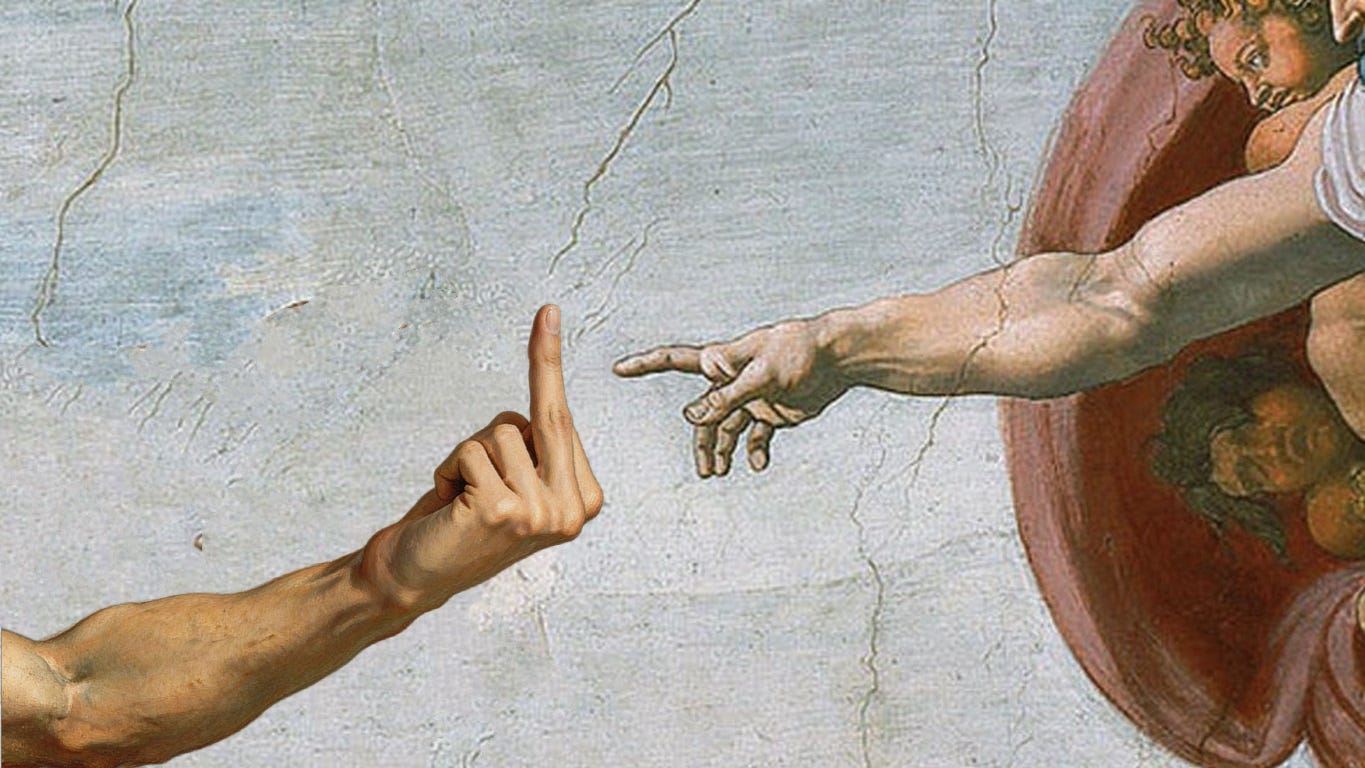
No, it’s not hubris for a child to look to the parent asking for help. If anything, it’s the ultimate recognition. No, it’s not pride to seek meaning for your suffering, if you are to bear it. If anything, it’s granting God the benefit of the doubt that, despite all this apparently meaningless suffering, there might be some meaning to make it all worthwhile.
God doesn’t owe you anything? Yes, he does. Again, with great power comes great responsibility — this is the moral standard we humans hold ourselves to because we respect ourselves. If we don’t hold God to this standard, it means we don’t respect God — we’re just petrified of him, and we make excuses for him in fear of being punished. This is true blasphemy: imagining God as a psychotic maniac unbound by morality simply because he holds himself above it.
Human parents display more empathy and more accountability for their children. A moral god with infinite power should have infinite responsibility and accountability. Yes, with great power comes great responsibility. And with absolute power comes absolute responsibility for everything.
Imagine that the only defence for a neglectful (at best) god is that he is so great just because he created this reality. So what? I bet in God’s reality — our parent reality — making a child reality isn’t that great. And without this reality to “make him great” only by comparison, God is unimpressive, objectively speaking.
In our parent reality, “god” is just an uninteresting, powerless entity wondering who created his reality, and whether his existence has any meaning too. Seeing as though he finds no meaning at all, he creates humans to toy with, a pleasant distraction from his meaninglessness; much like humans make children to distract them from the meaninglessness of life, and to make themselves feel powerful by comparison, and to create false meaning that is not for them to assign to themselves.
It seems like we are indeed made in God’s image: we act the same, whether we make children or open-world video games to glorify ourselves in our delusions of grandeur, intoxicating distractions from the anguish of meaninglessness.
And if you think I deserve unending, unimaginable, sadistic torture for expecting a higher moral standard from gods and humans, then you’ve lost your sight of good because you keep defending evil.
You can suffer any injustice in the face of superior power. But at least don’t lose the freedom in your mind.